
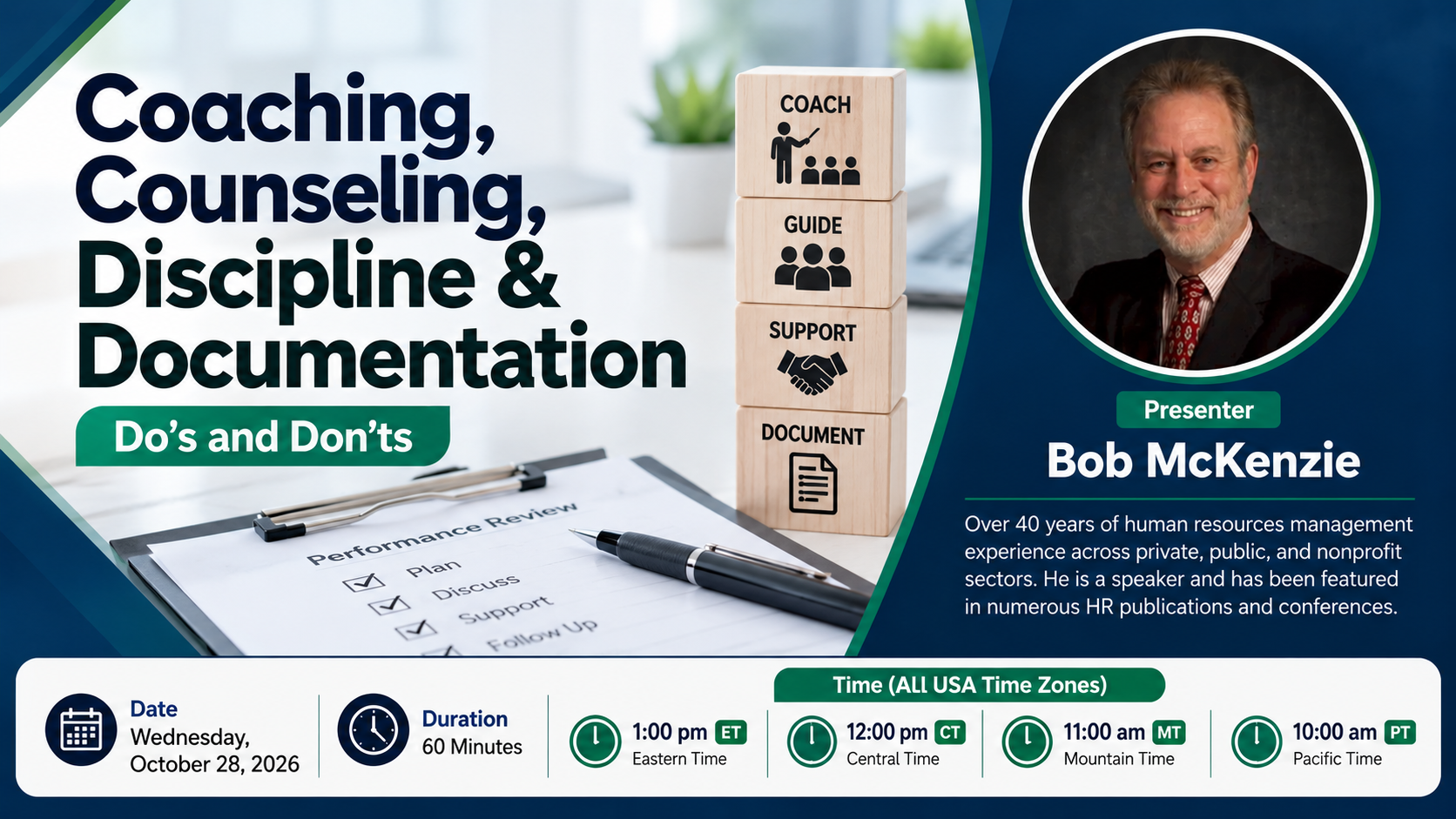
| Presenter: Bob McKenzie Date: Wednesday, October 28, 2026 Time: 1 pm ET | 12 pm CT | 11 am MT | 10 am PT Duration: 60 minutes |  |
Addressing performance or conduct concerns early — before they become formal disciplinary matters — protects both the employee and the organization. Effective coaching and counseling clearly explain what is unsatisfactory, what acceptable performance looks like, and what needs to change, while giving the employee an opportunity to explain circumstances, barriers, or contributing factors. It also means providing reasonable support such as training, coaching, mentoring, or clarification of expectations, and creating a clear path toward sustained improvement and follow-up.
Coaching and counseling are generally corrective and developmental rather than punitive. Discipline is a more formal response to misconduct or continued failure to meet expectations. Organizations should apply their own policies, employment agreements, and applicable law when deciding when a matter moves from coaching to discipline.
So ask yourself:
Am I addressing performance and conduct concerns early, before they become formal disciplinary matters?
Do I know the difference between coaching/counseling and discipline, and when a matter should move from one to the other?
Is my documentation factual, specific, and free of speculation or unsupported conclusions?
Would my written record hold up if it were reviewed months from now?
So join Bob McKenzie in this informative webinar on getting coaching, counseling, and documentation right.
Coaching & Counseling:
- Purpose of Coaching and Counseling
- Address performance or conduct concerns early, before they become formal disciplinary matters
- Clearly explain what is unsatisfactory, what acceptable performance looks like, and what needs to change
- Give the employee an opportunity to explain circumstances, barriers, or contributing factors
- Provide reasonable support such as training, coaching, mentoring, or clarification of expectations
- Create a clear path toward sustained improvement and follow-up
- Coaching/Counseling vs. Discipline
- Coaching and counseling are generally corrective and developmental rather than punitive
- Discipline is a more formal response to misconduct or continued failure to meet expectations
- Apply your own policies, employment agreements, and applicable law when deciding when a matter moves from coaching to discipline
- The Recommended Counseling Process
- Prepare: Review the facts, relevant policy, prior discussions, and objective examples before meeting
- Meet privately: Hold the conversation in an appropriate private setting and keep attendance limited to people who genuinely need to participate
- State the concern: Explain the specific performance or behavior issue without exaggeration or personal judgments
- Listen: Allow the employee to respond and ask questions; consider training, workload, communication, or other contributing factors
- Set expectations: Explain the required standard, how performance will be measured, and the timeframe for improvement
- Offer support: Identify available coaching, training, mentoring, resources, or other assistance
- Agree on follow-up: Set a reasonable review point and explain what successful improvement looks like
- Document: Create an accurate record of the discussion and retain it according to organizational policy
Documentation:
- Documentation Do's
- Be factual, specific, concise, and objective
- Record the date, participants, reason for the meeting, key concerns, employee response, expectations, support offered, and follow-up plan
- Use concrete examples rather than vague statements such as "bad attitude" or "poor performance"
- Document what was actually discussed; do not add unrelated issues afterward
- Keep documentation consistent with company policy and applicable employment requirements
- Document improvement as well as deficiencies when appropriate
- Complete documentation promptly while the discussion and facts are still fresh
- Store records securely and limit access to authorized personnel
- Documentation Don'ts
- Do not use insulting, emotional, sarcastic, discriminatory, or inflammatory language
- Do not speculate about an employee's motives or personal life
- Do not make unsupported conclusions or exaggerate the seriousness of an incident
- Do not change or backdate records to make the history appear different
- Do not include matters that were never discussed with the employee
- Do not characterize a coaching memo as punishment if it is intended only to document counseling
- Do not rely solely on memory when objective records, dates, or examples are available
- Do not promise outcomes or disciplinary decisions that have not been authorized
- What a Strong Counseling Memo Should Contain
- Employee name and meeting date
- Purpose and reason for the meeting
- Specific performance or conduct concerns
- Relevant facts or examples
- Employee's explanation or response
- Expected future performance or behavior
- Assistance or resources offered
- Follow-up date or review process
- Consequences or next steps if improvement is not sustained, where permitted by policy
- When Formal Documentation May Be Especially Important
- Previous coaching has not produced sustained improvement
- The issue is serious enough that a written record is appropriate
- Specific instructions or expectations need to be clearly memorialized
- A performance-improvement process may be necessary if deficiencies continue
- Key Management Principle
- The goal of effective coaching is not simply to create a paper trail
- The goal is to make the employee understand the problem, understand the required standard, have a fair opportunity to improve, and know how progress will be evaluated
- Good documentation supports that process by creating a clear, factual record
- Practical Manager Checklist
- Do I have specific facts/examples?
- Have I checked the applicable company policy?
- Can I explain the expected standard clearly?
- Have I allowed the employee to give their perspective?
- Have I identified reasonable support or training?
- Have I set measurable expectations and a follow-up point?
- Is my documentation factual and non-inflammatory?
- Does the written record accurately reflect what was discussed?
- Have I avoided including unrelated information?
- Have I stored the record appropriately?
Coaching and Counseling
- Purpose of coaching and counseling, and how it differs from discipline
- The recommended 8-step counseling process, from preparation through documentation
Documentation
- Documentation do's and don'ts
- What a strong counseling memo should contain
- When formal documentation becomes especially important
- The key management principle behind effective documentation
- A practical manager checklist for every counseling conversation
- Managers
- Branch Managers
- Store Managers
- HR Generalists
- HR Managers
- Plant Managers
- Management
- Business Owners
Bob McKenzie
Bob McKenzie has over 40 years of human resources management experience. His background includes a wide range of hands-on HR practices including in all aspects of Human Resources. And is a variety of industries in with private sector, public sector and nonprofit employers.
Bob has been cited in a number of Human Resources trade publications. Among them are HR.com, HR Magazine, HR Florida Review, Vault.com, BNA and the Institute of Management and Administration and the Business Journals. He has been a speaker at a number of conferences as well as audio and web-based seminars.
Bob is a graduate of Rider University where he received a Bachelor of Science in Commerce Degree and double majored in Industrial Relations and Organizational Behavior and lives in Brunswick, GA.
After registering, you'll receive a confirmation email with your unique login details and access to presentation materials. All documents are downloadable and ideal for team training or reference.
- Internet Speed: Preferably above 1 Mbps
- Headset: Any decent headset and microphone which can be used to talk and hear clearly
No problem. You can get access to an On-Demand webinar. Use it as a training tool at your convenience.
Toll-Free No: 1-302-444-0162
Email: training@skillacquire.com
Address: 651 N. Broad Street, Suite 206, Middletown, DE 19709