
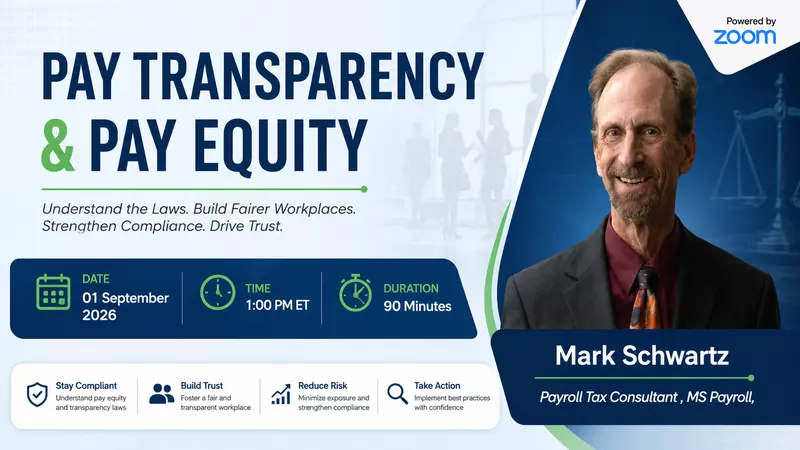
| Presenter: Mark Schwartz Date: Tuesday, September 01, 2026 Time: 1 pm ET | 12 pm CT | 11 am MT | 10 am PT Duration: 90 minutes |  |
Pay transparency refers to the practice of disclosing compensation-related information to employees, job applicants, or the public. This can include details such as salary ranges, benefits, and wage changes due to promotions. Recently, many states and local jurisdictions have enacted pay transparency laws that require employers to disclose wage information to prospective candidates and current employees. These laws aim to address pay equity and ensure that employees can discuss salaries freely, promoting fairness in the workplace.
Pay equity is the legal concept that equal work deserves equal pay regardless of an employee’s race, gender, ethnicity, age, religion, or other non-job-related factors. This means employees who perform the same or similar jobs should receive equal pay. Pay equity is important because it helps ensure that all employees are treated fairly by eliminating wage discrimination, which helps promote diversity and inclusion in the workplace.
The Federal Government has no specific pay transparency law. However, over the past several years, almost every state has some version of employer regulation over pay transparency. Many states enacted laws in 2025. The Federal Government's Equal Pay Act and Lily Ledbetter Act set minimum standards for pay equity. States also have their own pay equity legislation.
So ask yourself:
Have I kept current on my state(s) pay equity and pay transparency laws?
Do I understand the Equal Pay Act and the Lily Ledbetter Fair Pay Act? What are their important differences? What states enacted other measures to their laws?
Do I understand the benefits and pitfalls of enacting pay transparency and pay equity in our business?
How can I enact measures to effectively implement pay equity and transparency into our business and HR culture?
How do I talk to employees about our company’s pay equity and transparency?
So join Mark Schwartz in this informative webinar to be up to date on industry standards and compliance.
Pay Transparency:
- Its goals and benefits to your company, including the company culture
- Employee Retention
- Stronger recruiting efforts
- It’s possible to have negative effects on your employees and HR
- Negotiations
- Implementation Issues
- Poaching
- The four steps for implementing Pay Transparency
- Conducting a pay audit
- Delivering transparent communication
- Fusing Pay transparency into the work culture
- Goals and progress reports
- State and local laws
- General requirements under all State regulations
- State and local specific laws from California, Colorado, Connecticut, Hawaii, New York, and more
Equal Pay:
- The Equal Pay Act of 1963 – Demands equal pay for work based on
- Skill
- Effort
- Responsibility
- The Lily Ledbetter Fair Pay Act of 2009 addresses when a claim of unequal pay based on sex can be filed
- Example of claims
- Limitations
- Impact on Employers
- The Importance of Compliance with Equal Pay Laws and Best Practices
- How to discuss pay equity with employees
- Key Discussion Points in Interviews, Hiring, and During Employment
- Answering Common Employee Questions
- State Equal Pay Regulations
- General Rules for All States
- Expanded Rules for California, New York, and Maryland
- Other states with unique rules
Pay Transparency
- Goals and benefits to company culture, employee retention, and recruiting
- Potential negative effects, including negotiation dynamics, implementation friction, and poaching risks
- 4 steps for implementation
- Conducting a pay audit
- Delivering transparent communication
- Integrating pay transparency into company culture
- Tracking goals and progress
- State and local law variations, including California, Colorado, Connecticut, Hawaii, New York, and Maryland
Equal Pay
- Federal regulations
- Equal Pay Act of 1963
- Lily Ledbetter Fair Pay Act of 2009
- Best practices for discussing pay equity, managing employee Q&A, and interview guidelines
- HR managers
- Payroll Managers
- Budget Personnel
- HR and Payroll Compliance Managers
- Department Managers
Mark Schwartz
Mark Schwartz is an employment tax specialist with over 25 years of payroll tax experience. He has been an employment tax auditor with the state of California. During that time, he managed an audit caseload of over 25 businesses – from home-based to large multinational corporations. He understands the full range of employment tax law for both federal and state purposes. For the last 15 years, Mark has helped hundreds of clients sort out confusing details to run payroll operations effectively. Mark prides himself on listening attentively to his clients and only ceasing his consulting duties once the client is delighted with the answers and advice. Mark’s audio conferences are jam-packed with all details applicable to any topic. He incorporates his experience with the laws and regulations, giving audiences a leg up on applying the knowledge to their business. Furthermore, Mark is generous with his time for anyone who attends a live conference. He will help research anything on the given topic – free of charge.
After registering, you'll receive a confirmation email with your unique login details and access to presentation materials. All documents are downloadable and ideal for team training or reference.
- Internet Speed: Preferably above 1 Mbps
- Headset: Any decent headset and microphone which can be used to talk and hear clearly
No problem. You can get access to an On-Demand webinar. Use it as a training tool at your convenience.
Toll-Free No: 1-302-444-0162
Email: training@skillacquire.com
Address: 651 N. Broad Street, Suite 206, Middletown, DE 19709