
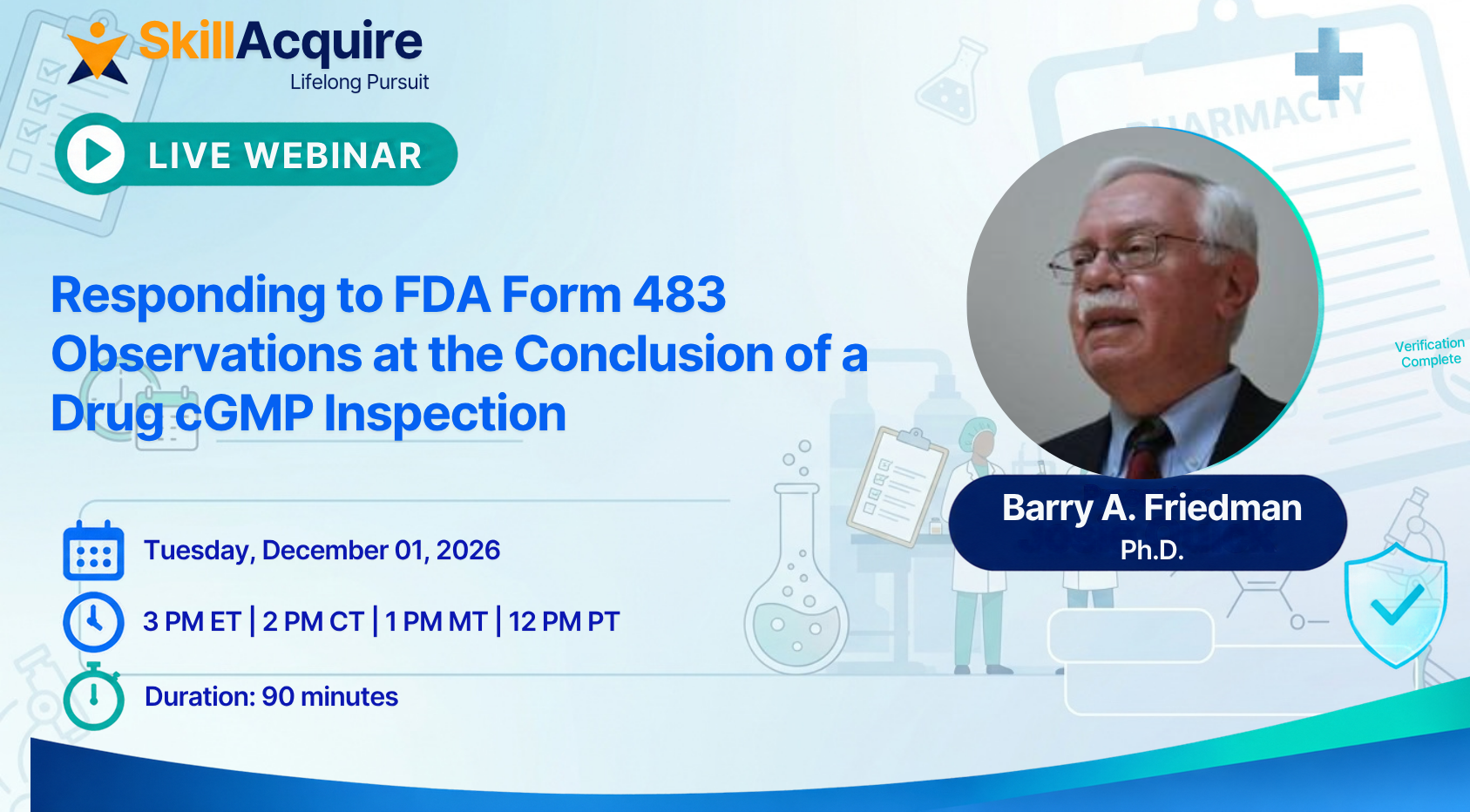
| Presenter: Barry A. Friedman, PhD Date: Tuesday, December 1, 2026 Time: 3 pm ET | 2 pm CT | 1 pm MT | 12 pm PT Duration: 90 minutes |  |
Course Description
FDA's March 2026 DRAFT guidance (Docket No. FDA-2025-D-1504) marks the Agency's first standalone document dedicated specifically to how establishments should respond to a Form 483 following a drug CGMP inspection. This presentation translates that guidance into a practical playbook for Quality, Regulatory Affairs, and site leadership teams preparing for or recovering from an inspection.
This presentation is organized in five parts. Part 1 explains what a Form 483 is, how it differs from a Warning Letter, and why FDA issued the guidance — namely, a recurring pattern of incomplete, unfocused, or root-cause-avoidant responses that hampered the Agency's ability to evaluate remediation. Part 2 details the required response format under Section III: establishment identity, a copy of the 483, preparer and signatory identification, an executive summary table, per-observation discussion, translation requirements, interim reporting expectations, submission channels, and the critical 15-business-day response window. Part 3 covers Section IV's substantive recommendations — prioritizing and clustering observations, engaging consultants where warranted, assigning management responsibility, building investigation teams and plans, conducting root-cause analysis, and developing and evaluating CAPA effectiveness. Part 4 addresses Section V's process for raising scientific or technical disagreements with FDA's findings.
The presentation closes with a practical synthesis — common reasons FDA rejects 483 responses and a readiness checklist — followed by an appendix of five real 2025–2026 Warning Letter case studies (Fareva Morton Grove, Simtra BioPharma, Tentamus India, Medline, and Purolea Cosmetics) illustrating the guidance's principles in enforcement practice, including FDA's first-ever citation for inappropriate AI use in CGMP documentation.
Key takeaway: A credible 483 response must be timely, consolidated, and demonstrably address root cause and systemic scope — not merely the literal wording of the cited observation — with visible executive management accountability throughout.
Learning Outcomes
- Understand what a Form 483 is, how it differs from a Warning Letter, and why FDA issued the guidance
- Learn the required response format which establishes facility identity, a copy of the 483, preparer and signatory identification, and an executive summary table
- Identify the substantive recommendations — prioritizing and clustering observations, engaging consultants where warranted, assigning management responsibility, etc.
- Addresses the process for raising scientific or technical disagreements with FDA's findings
- Understand how to develop the closure with a practical synthesis to include common reasons FDA rejects 483 responses
- Provides a sample of a readiness checklist
- Demonstrates within an appendix five real 2025–2026 Warning Letter case studies to include the inappropriate use of AI within cGMP documentation
Areas Covered in the Session
- FDA Guidance Overview
- Purpose of Docket No. FDA-2025-D-1504 (March 2026 guidance).
- Key differences between Form 483s and Warning Letters.
- Common response mistakes FDA aims to correct.
- Required Response Format (Section III)
- Establishment identity and preparer/signatory details.
- Creating an executive summary table and per-observation structure.
- Translation rules, submission channels, and the 15-business-day deadline.
- Substantive Action & CAPA Strategy (Section IV)
- Prioritizing and clustering observations.
- Management responsibility and engaging external consultants.
- Building investigation teams, root-cause analysis, and CAPA effectiveness checks.
- Handling Disagreements (Section V)
- Formal process for raising scientific or technical disputes with FDA.
- Response Synthesis & Inspection Readiness
- Top reasons FDA rejects 483 responses.
- Practical readiness checklist for site leadership.
- 2025–2026 Warning Letter Case Studies
- Real-world examples: Fareva, Simtra, Tentamus, Medline, and Purolea.
- FDA's first citation for inappropriate AI use in cGMP documentation.
- Interactive live Q&A session with Barry A. Friedman
Recommended Participants
- Quality Assurance
- Quality Control
- Chemists
- Microbiologists
- Manufacturing
- Facility Engineering
- Validation
- Project Management
- Regulatory Compliance
About the Presenter
Barry A. Friedman, Ph.D., is a Senior Consultant in the Biotechnology, Regulatory Compliance and Aseptic Processing arena. From 2000 to 2007, Dr. Friedman was associated with Cambrex Bio Science Baltimore, a contract manufacturer of GMP bulk biopharmaceuticals located in Baltimore, MD. In that capacity as the Director, Quality Control, he managed a multi-shift Department of thirty-one individuals involved in Client management, the receipt and testing of raw materials, environmental monitoring and microbiology, analytical chemistry and QC compliance for the production of Phase 1, 2, 3 and commercial products manufactured from bacteria, yeast and mammalian cells. In this capacity Dr Friedman enjoyed many client and regulatory interactions.
Prior to 2000, Dr. Friedman was the Laboratory Director for Chesapeake Biological Laboratories, a contract Aseptic Fill ‘n Finish manufacturer located in Baltimore, MD. He was involved with the microbiology, environmental monitoring and analytical chemistry for Phase 1, 2, 3 and commercial products aseptically filled/lyophilized. Dr. Friedman has over 30 years of industrial managerial experience in various aspects of biopharmaceuticals and medical devices to include quality control, sterility assurance, microbiological/analytical validations and fermentation technology. In addition to the associations listed above, other associations have included W.R. Grace, Sigma Chemical Co., Sherwood Medical, Becton Dickinson, American Cyanamid and Union Carbide.
Dr. Friedman received his B.S. degree in Microbiology from The Ohio State University, his M.S. from Michigan State University in Microbial Genetics and his Ph.D. from The Ohio State University in Microbiology.
Dr. Friedman is a frequent seminar speaker and specializes in the areas of regulatory compliance, internal auditing, aseptic processing for sterile drug products, multi-departmental interactions, validations and the requirements for the manufacture of Phase 1, 2 and 3 clinical trial materials. He has recently given presentations for the FDA, GBPR, PDA, PTi. He is a member of AAMI, ASM, and PDA. He served as a Captain in the Medical Service Corps, U.S. Army and is the past President of the Capital Area Chapter, PDA. He recently received the James Agalloco award from PDA which is awarded to a PDA faculty member who exemplifies outstanding performance in education.
Additional Information
You will receive an email with login information and handouts (presentation slides) that you can print and share with all participants at your location.
- Internet Speed: Preferably above 1 Mbps
- Headset: Any decent headset and microphone which can be used to talk and hear clearly
No problem. You can get access to an On-Demand webinar. Use it as a training tool at your convenience.
Toll-Free No: 1-302-444-0162
Email:training@skillacquire.com
Address: 651 N. Broad Street, Suite 206, Middletown, DE 19709