
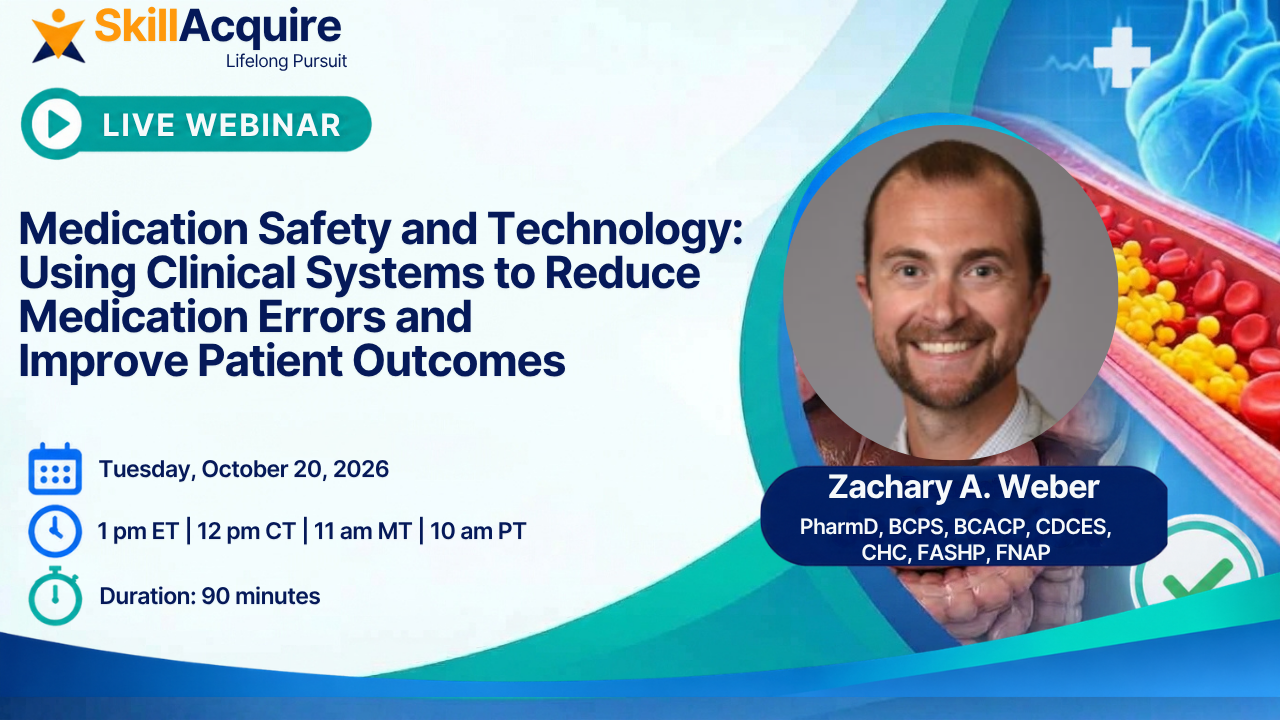
| Presenter: Zachary A. Weber, PharmD, BCPS, BCACP, CDCES, CHC, FASHP, FNAP Date: Tuesday, October 20, 2026 Time: 1:00 pm ET | 12:00 pm CT | 11:00 am MT | 10:00 am PT Duration: 90 minutes |  |
Course Description
The 2026 ACC/AHA Guideline on the Management of Dyslipidemia represents a substantial evolution in the prevention and treatment of atherosclerotic cardiovascular disease (ASCVD), replacing the 2018 cholesterol guidelines and broadening its focus beyond LDL cholesterol to encompass hypertriglyceridemia, lipoprotein(a), and other atherogenic lipoproteins. This webinar will translate the guideline’s most important updates into practical strategies that healthcare professionals can apply to patient care.
Participants will explore the shift from the Pooled Cohort Equations to the PREVENT-ASCVD equations for estimating 10- and 30-year cardiovascular risk and learn how risk-enhancing factors and coronary artery calcium (CAC) scoring can further personalize treatment decisions. The program will also examine the return of specific LDL-C and non–HDL-C treatment goals, including more aggressive targets for patients at greatest ASCVD risk.
Beyond the traditional lipid panel, the webinar will address the expanding roles of apolipoprotein B (ApoB) and lipoprotein(a) [Lp(a)] in identifying residual and inherited cardiovascular risk, including the recommendation to measure Lp(a) at least once in all adults. Attendees will also review contemporary pharmacologic strategies, including the appropriate use of statins and non-statin therapies such as ezetimibe, PCSK9 monoclonal antibodies, bempedoic acid, inclisiran, and selected therapies for severe hypertriglyceridemia.
Using practical clinical scenarios, this webinar will help participants integrate updated risk assessment, laboratory testing, treatment targets, lifestyle interventions, and pharmacotherapy into individualized dyslipidemia management. By the conclusion of the program, attendees will be better prepared to identify patients who warrant treatment, select appropriate lipid-lowering strategies, and intensify therapy when treatment goals remain unmet.
Learning Outcomes
- Identify key practice-changing recommendations in the 2026 ACC/AHA dyslipidemia guideline and distinguish them from prior approaches to lipid management.
- Apply the PREVENT-ASCVD equations to estimate 10- and 30-year ASCVD risk and guide lipid-lowering therapy decisions in appropriate primary prevention patients.
- Incorporate risk-enhancing factors and coronary artery calcium (CAC) scoring into individualized ASCVD risk assessment and shared treatment decisions.
- Determine appropriate LDL-C and non–HDL-C treatment goals based on a patient’s ASCVD risk, prevention setting, and relevant comorbidities.
- Interpret ApoB and Lp(a) measurements and identify clinical situations in which these biomarkers can refine ASCVD risk assessment or guide treatment intensification.
- Select appropriate statin and non-statin lipid-lowering therapies—including ezetimibe, PCSK9 monoclonal antibodies, bempedoic acid, or inclisiran—to achieve guideline-recommended lipid goals.
- Develop evidence-based management strategies for patients with hypertriglyceridemia that address both ASCVD risk reduction and prevention of acute pancreatitis.
- Construct an individualized dyslipidemia management plan that integrates lifestyle interventions, risk assessment, laboratory monitoring, lipid-lowering pharmacotherapy, and appropriate treatment intensification.
Areas Covered in the Session
- Major Changes in the 2026 Dyslipidemia Guideline – Review of the most important practice-changing recommendations and how the new guideline differs from the 2018 cholesterol guideline.
- Updated ASCVD Risk Assessment with PREVENT – Introduction of the PREVENT-ASCVD equations for estimating 10- and 30-year cardiovascular risk and their role in primary prevention decisions.
- Personalizing Cardiovascular Risk – Application of the guideline's "CPR" approach: Calculate risk, Personalize using factors not captured by PREVENT, and potentially Reclassify risk using coronary artery calcium (CAC).
- The Return of LDL-C and Non–HDL-C Treatment Goals – Discussion of specific lipid targets and percentage LDL-C reductions according to ASCVD risk and prevention category.
- Beyond the Standard Lipid Panel: ApoB and Lp(a) – Appropriate use and interpretation of ApoB to identify residual atherogenic risk and the new recommendation to measure Lp(a) at least once in all adults.
- Using Coronary Artery Calcium to Guide Treatment – Incorporation of CAC scores, including incidental coronary calcification, to refine ASCVD risk and guide initiation or intensification of lipid-lowering therapy.
- Primary and Secondary ASCVD Prevention – Selection and intensity of lipid-lowering therapy based on PREVENT risk categories, established ASCVD, and updated LDL-C/non–HDL-C goals.
- Expanding the Lipid-Lowering Toolbox – Evidence-based use of statins and non-statin therapies, including ezetimibe, PCSK9 monoclonal antibodies, bempedoic acid, or inclisiran to achieve recommended lipid goals.
- Hypertriglyceridemia and Special Patient Populations – Updated approaches to elevated triglycerides, prevention of pancreatitis, and dyslipidemia management in populations (e.g. patients with diabetes, CKD, HIV, familial hypercholesterolemia, pregnancy, or cancer).
- Translating the Guideline into Everyday Practice – Integration of lifestyle modifications, laboratory monitoring, medication selection, treatment intensification, and follow-up into individualized patient care, reinforced through clinical case applications.
Recommended Participants
- Formulation & Process Chemists
- Analytical Validation Managers
- Regulatory Affairs (RA) Directors
- Clinical Researchers & Principal Investigators
- Medical Science Liaisons
- Clinical Pharmacists
- Quality Assurance Managers in Pharma
- Laboratory Managers and Technicians
- Analytical Chemists
- Bioprocess Scientists
- Formulation development personnel
- Quality & Regulatory Executives
- Production Managers
- Clinical Research Coordinator
- Clinical Site Managers
- Data Manager
- Clinical Research Scientist
- Director Clinical Research
About the Presenter
Zachary A. Weber, PharmD, BCPS, BCACP, CDCES, CHC, FASHP, FNAP is the Director of Interprofessional Education and Clinical Professor of Pharmacy Practice for Purdue University College of Pharmacy, the Assistant Dean for Education for the Indiana University Interprofessional Practice and Education Center (IU IPE Center), and an Adjunct Professor of Medicine for Indiana University School of Medicine. He received his PharmD degree from Purdue University and completed a Pharmacy Practice residency at the Roudebush VA Medical Center in Indianapolis, IN followed by an Ambulatory Care Specialty residency at Duke University Hospital in Durham, NC. At the College of Pharmacy, he is responsible for the implementation and oversight of the required, longitudinal IPE curriculum for Doctor of Pharmacy students, and at the IU IPE Center he oversees and manages the educational content and delivery of the Indiana statewide Interprofessional Core Curriculum. Dr. Weber has received multiple teaching and education awards that include the Purdue College of Pharmacy Faculty Preceptor of the Year, Purdue College of Pharmacy Dr. Aziz Outstanding Teacher of the Year, Purdue University Class of 1922 Outstanding Innovation in Helping Students Learn Award, the American Association of Colleges of Pharmacy (AACP) Pharmacy Practice Section (PPS) Interprofessional Collaborative Practice Award, and has been selected as a Fellow in the Purdue University Teaching Academy. His research interests include interprofessional education and collaborative practice, contemporary and innovative teaching pedagogy, and expanding progressive ambulatory care clinical pharmacist roles.
Additional Information
You will receive an email with login information and handouts (presentation slides) that you can print and share with all participants at your location.
- Internet Speed: Preferably above 1 Mbps
- Headset: Any decent headset and microphone which can be used to talk and hear clearly
No problem. You can get access to an On-Demand webinar. Use it as a training tool at your convenience.
Toll-Free No: 1-302-444-0162
Email: training@skillacquire.com
Address: 651 N. Broad Street, Suite 206, Middletown, DE 19709